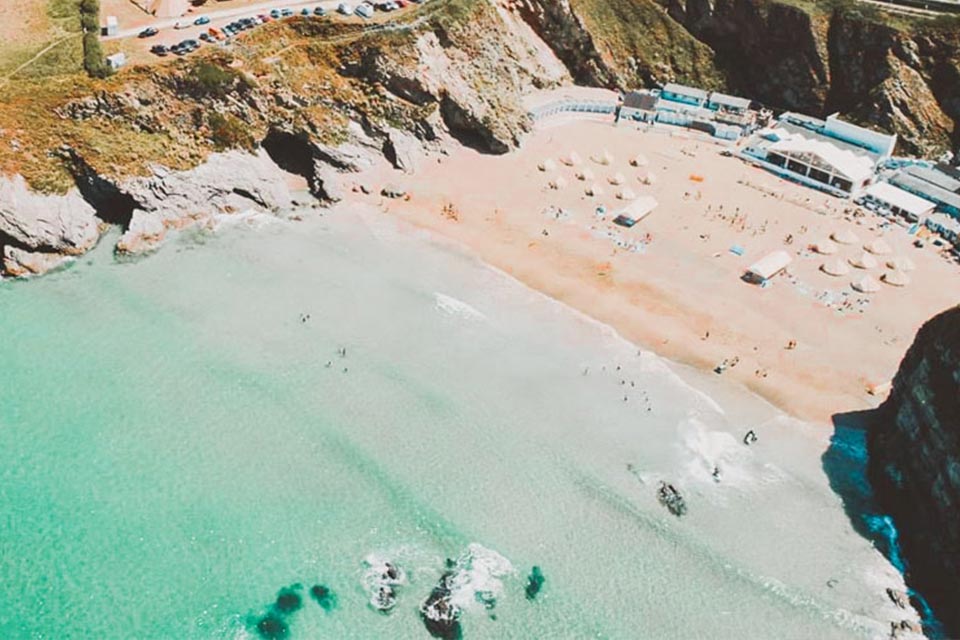
Something extraordinary is happening in the waters off Cornwall’s south coast. Divers are surfacing wide-eyed with stories of multiple octopuses on a single dive. Fishermen are hauling tonnes of them from lobster pots. Snorkellers are watching them jet-propel across the seabed, camouflage against rocks, and even reach out to grab underwater cameras. Cornwall’s seas have always been full of surprises, but 2025 delivered something nobody expected: the biggest octopus bloom in 75 years.
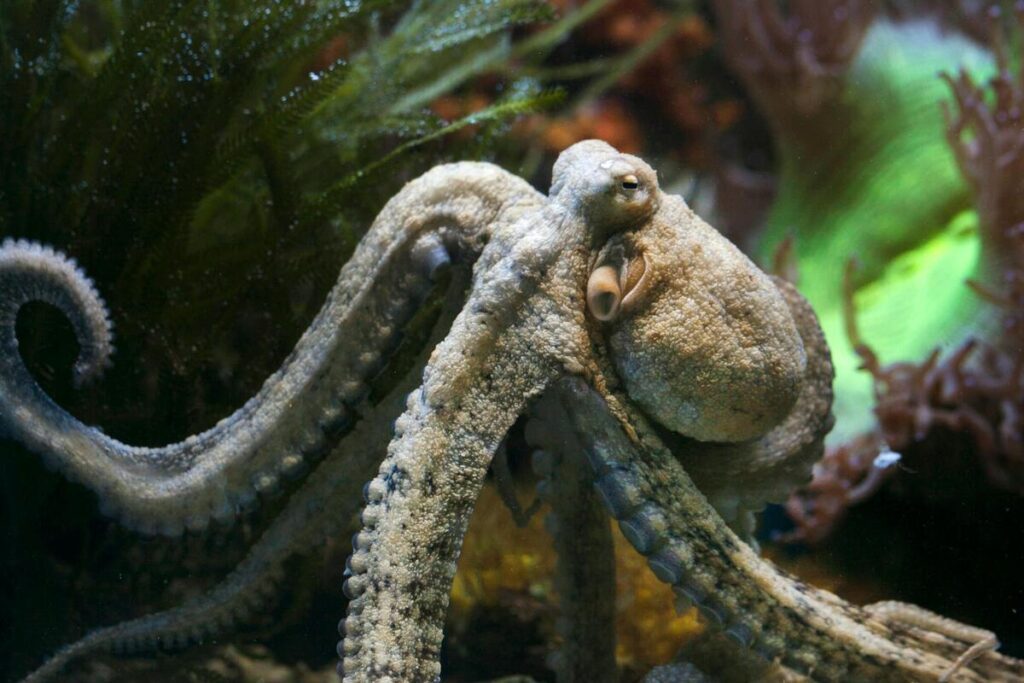 Octopus in Cornwall
But why?
The short answer is warmer seas. The species behind the bloom is the common or Mediterranean octopus, one that is at its most northerly range in the English Channel and is normally rarely seen in British waters.
The common octopus typically favours the warmer waters of southern Europe and the Mediterranean, but rising sea temperatures are allowing the species to extend its range further north. Sea temperatures in the south west reached up to 4°C above normal in 2025, creating particularly favourable conditions for reproduction and survival. Sustained easterly winds also appear to have helped transport octopus larvae from the Channel Islands and France to UK coastlines.
Matt Slater, marine conservation officer at Cornwall Wildlife Trust, described it as “an exceptional octopus population explosion, the like of which hasn’t been seen in our waters for 75 years.” With warming seas, warmer water species are moving north, meaning these blooms may become more frequent in the years ahead.
Warming Seas, Changing Waters
The octopus bloom is not just a wildlife spectacle, it is a direct signal of how rapidly Cornwall’s seas are changing. The common octopus has always existed at the very northern edge of its range in the English Channel, kept in check by water temperatures that were historically too cold for large-scale breeding.
Rising sea temperatures driven by climate change are shifting that boundary northward, giving warm-water species like the common octopus the conditions they need to thrive in waters where they were previously scarce.
Cornwall’s seas warmed by up to 4°C above normal during 2025, part of a broader marine heatwave that affected waters across the UK. Scientists at the Marine Biological Association are now investigating whether blooms like this will become a regular feature of south-west waters as temperatures continue to rise, or whether 2025 was an exceptional spike in an otherwise gradual trend.
The picture is complex. While the octopus bloom is remarkable to witness, it sits alongside other climate-driven changes that are less welcome, cod and haddock retreating north as waters warm, invasive Pacific oysters colonising Cornish estuaries, and the arrival of non-native species that could disrupt local ecosystems.
For Cornwall’s fishing communities such as Mevagissey, Looe, Padstow, Newlyn and others, the boom in octopus has come at the direct expense of crab and lobster catches, with some fishermen describing the situation as a crisis for their livelihoods.
What the octopus bloom makes clear is that Cornwall’s seas are not static. They are changing and changing faster than at any point in living memory.
 Warmer Seas in Cornwall
The impact on Cornish Fishermen
At the peak of the bloom in June 2025, a fisher working in Falmouth Bay with 100 lobster pots could expect to land three tonnes of octopus per week.
One boat fishing out of Newlyn brought home over 20 tonnes of octopus, worth £142,000, from just three days at sea.
Between £6.7 million and £9.4 million worth of common octopus was landed on the south coast of the UK from January to August 2025 alone. For those who adapted quickly, it was an extraordinary and unexpected windfall.
But the other side of the ledger is far darker. The common octopus is a voracious predator of exactly the shellfish that Cornish fishermen depend on, brown crab, lobster, and scallop.
Catch rates for those species fell by between 30% and 50% in 2025, raising serious concerns about long-term damage to stocks. To put that in context, a boat that previously landed a tonne of crab a day could find itself landing almost nothing, while hauling pot after pot of octopus it had no ready market for.
A survey of 40 fishermen revealed mixed impacts from the octopus surge. While some adapted to catching octopus and benefited economically for a period, more than half reported negative impacts, particularly those targeting brown crabs, lobsters and scallops, which suffered heavy predation.
The problem is not just the direct loss of catch. Octopus do not simply outcompete crab and lobster for food, they actively hunt and eat them, hollowing out the populations that local fishing businesses rely on year after year. With lobster catches down by 30% and brown crab and scallop catches down by over 50%, many fishers are now worried about a future in which there is simply nothing left to catch.
Young Cornish Fishermen
What Is an Octopus Bloom?
An octopus bloom is a sudden, dramatic explosion in the population of octopus in a given area. It is a natural phenomenon, but an exceptionally rare one. Historically, only a handful of major population blooms have been recorded over the past 125 years, in 1899–1900, 1932–33, 1950–51, and now from 2025 onwards.
The octopus bloom of 2025 has been the largest seen in Cornish waters since 1950. To put that in numbers: landings of common octopus by commercial fisheries were reported to be almost 65 times higher than recent annual averages. More than 1,200 tonnes of octopus was caught by fishermen in UK waters in the summer of 2025 alone, a dramatic increase on previous years, when more than 200 tonnes had only been landed once since 2021.
Will the Bloom Continue?
From historical evidence, blooms typically last a couple of years, so there should still be octopuses in Cornish waters through 2026. Reports of breeding activity and juvenile octopuses in UK waters suggest the population is sustaining itself for now.
Scientists are watching closely. If sea temperatures remain elevated, blooms like this could become a more regular feature of Cornwall’s waters, transforming what was once a rare and thrilling encounter into something visitors can realistically plan around.
For tourists, the message is simple: there has never been a better time to get in the water. Whether you are an experienced diver or a first-time snorkeller exploring one of Cornwall’s incredible beaches for the first time, the chance to encounter one of the ocean’s most intelligent and spectacular creatures, right here on Cornwall’s doorstep, is not one to miss.
Underwater Octopus
Where Can You See Octopus in Cornwall?
This is the question on every visitor’s lips, and the good news is that your chances of seeing one have never been higher. The bloom has been concentrated along the south coast, making the following spots your best bets.
The Lizard Peninsula
The Lizard is the hotspot. Snorkellers and divers have reported a surge in sightings especially around this stretch of coastline, drawn by its rocky seabed, sheltered coves, and exceptional water clarity. Kynance Cove is one of Cornwall’s most beautiful beaches and a great base for exploring the water’s edge, while Kennack Sands on the eastern side of the peninsula offers calmer, shallower conditions well suited to snorkelling. Poldhu Cove is another excellent Lizard option, particularly popular with families. For a full overview of the area, the Lizard location guide is a great starting point.
Why Are There So Many Octopus in Cornwall Right Now? 8
Falmouth Bay
Falmouth Bay saw some of the most intense octopus activity during the peak of the bloom. The bay is suitable for all levels of diver and snorkeller, with shallow entry points and excellent visibility. Maenporth Beach just south of Falmouth is a sheltered, rocky-edged beach ideal for getting into the water, while Castle Beach offers a quieter alternative nearby. Explore the full Falmouth guide for more on what the area has to offer.
falmouths gylly beach
Mevagissey and the South East Coast
The waters around Mevagissey were among the most dramatically affected by the bloom, one local fisherman famously reported catching 150 octopus in a single day at the peak. Carne Beach on the nearby Roseland Peninsula is known for its crystal-clear waters and is considered one of the best spots in Cornwall for snorkelling and diving, with rich marine life and excellent visibility. The Mevagissey location guide covers the wider area well if you are basing yourself in that part of the county.
The best months to look are summer through to early autumn, when sea temperatures are at their warmest and the water is at its clearest. You can explore the full range of South East Cornwall beaches and West Cornwall beaches to plan your route.
Why Are There So Many Octopus in Cornwall Right Now? 9
If You’re Hungry After Your Dive
A happy coincidence of the bloom is that Cornish octopus has become available fresh from local ports, and it has found its way onto menus across the county. If you fancy trying it, Cornwall is one of the best places in the UK to eat really exceptional seafood.
Our guide to the best seafood restaurants in Cornwall is a good place to start, and if you are in St Ives, check out our picks for the best seafood restaurants in St Ives too. For something more casual, our round-up of the best fish and chips in Cornwall covers the county’s finest chippies.
See It for Yourself
If you want to see just how extraordinary the bloom has been up close, Cornwall-based ocean channel SoulTee captured it on camera in a way that words simply can’t do justice. Their footage shows exactly what divers have been experiencing beneath the surface this year, and it is well worth a watch.