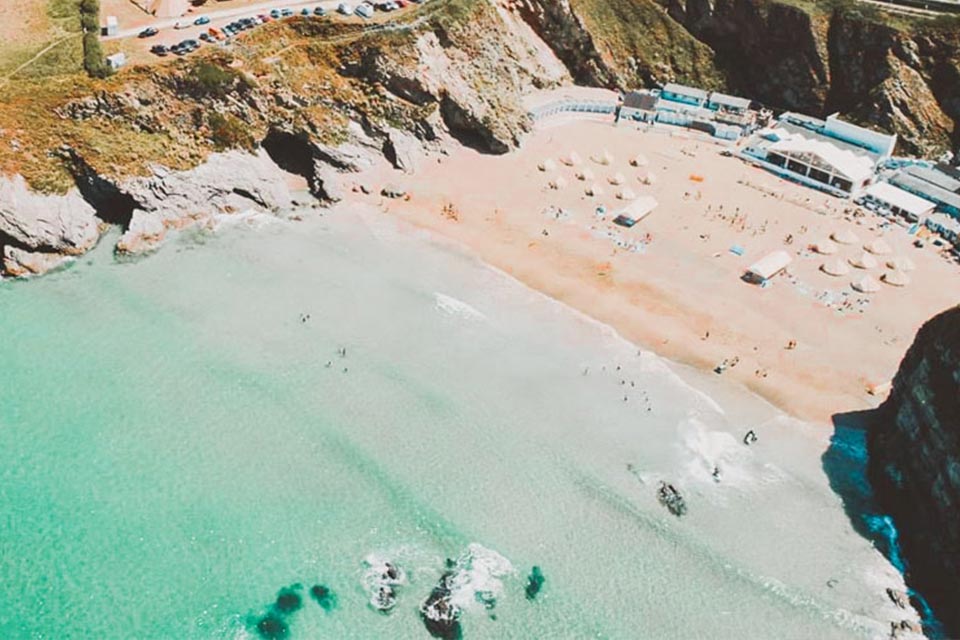
The tell-tale of a good pub is by how much is hanging from the ceiling beams.
You’ve just finished a long walk along the coast path, the wind has done its best with your hair, and your boots are caked in Cornish mud.
Now all you want is a low-beamed ceiling, a roaring fire, a pint of something local, and a plate of food that actually tastes of the county you’re standing in.
Cornwall does this better than almost anywhere in Britain. The county has a pub culture that goes back centuries, shaped by fishing communities, tin miners, smugglers, and the kind of fierce local pride that means the landlord still knows the name of your dog after one visit.
Finding the best pubs in Cornwall takes a little knowledge, and that’s exactly what this guide is for. We’ve sat in the snugs, eaten the food, talked to the bar staff, and checked the beer lines so you don’t have to.
1. The Blue Anchor, Helston
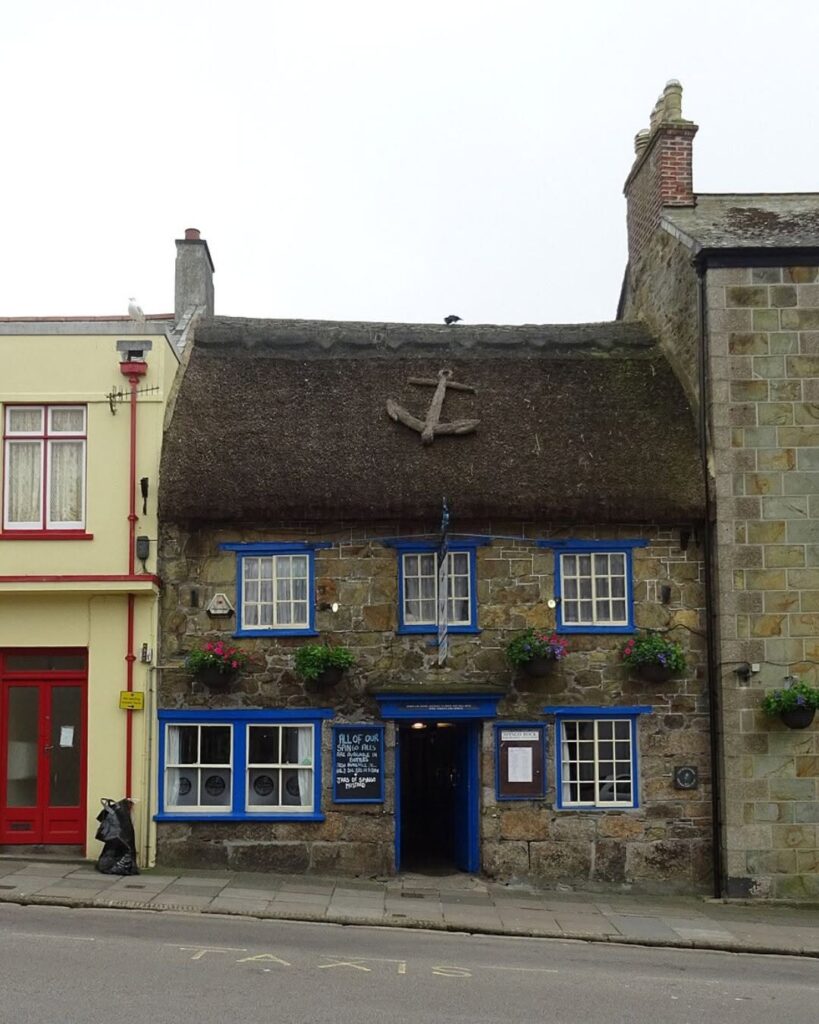
If you only visit one pub in Cornwall, make it this one. The Blue Anchor is one of the last true home-brew houses left in England, and it looks it: thatched roof, granite frontage, a warren of small dark rooms off a flagstone passage, worn benches, and not one thing in the building that was put there to be photographed.
A winter pub of the highest order, cold day, small room, fire lit, Spingo in the glass, though the yard out the back is a fine place to sit in summer. Ask about the brewhouse; they’re usually happy to point you at it.
The building is thought to have started life as a monks’ rest house before becoming an inn, with parts dating to the 15th century, and beer has been brewed on the premises for centuries. The Spingo ales are still made in the brewhouse behind the pub, using the same water source. Helston’s other great survival is Flora Day on 8 May, when the Furry Dance winds through the streets and straight in and out of houses and shops along the way.
Walk south from Helston through the Penrose Estate to Loe Pool, Cornwall’s largest natural lake, and out to Loe Bar Beach, the shingle bank separating the freshwater pool from the sea. Carry on north to Porthleven if you’ve got the afternoon.
 32 Proper Cornish Pubs Worth Driving For 33
2. The Pandora Inn, Mylor Creek
Few pubs anywhere have a setting like the Pandora. It sits at the end of a narrow lane on tidal Mylor Creek near Falmouth, and at high tide the water comes right up to the floating pontoon that serves as its terrace. Inside, the thatched, Grade II listed building is all low beams, flagstones, cubbyhole rooms and open fires kept going from October through to April. Local crab, mussels and daily fish specials.
Peak summer waterside pub, arrive by boat and moor up if you possibly can, but it’s arguably better on a wet January afternoon with the fire going and the creek empty.
The pub is named after HMS Pandora, the Royal Navy frigate sent to the Pacific to hunt down the Bounty mutineers. She was wrecked on the Great Barrier Reef in 1791, and the story goes that her disgraced captain came home and bought this inn. The thatch burned in 2011 and was painstakingly rebuilt, which is why the building looks rather better than its 13th-century bones would suggest.
Loe Beach at Feock is minutes away on the Carrick Roads, sheltered, shallow and good for paddleboarding. Or walk the creekside paths from Mylor Bridge round to Mylor Churchtown and back.
 32 Proper Cornish Pubs Worth Driving For 34
Credit: https://www.pandorainn.com/
3. The Queens Arms, Botallack
Botallack is where Cornwall’s mining coast is at its most spectacular, and the Queens Arms is the village’s granite local. Low ceilings, a proper fire, unfussy furniture and the settled feel of a pub that serves the same people every week rather than a coachload every August.
A winter pub with a summer garden: come in a westerly gale when the Atlantic is battering the cliffs a few hundred yards away, or sit out on a long evening after walking the mine paths. Muddy boots and dogs are entirely normal.
Below the village, the Crowns Engine Houses cling to the rock just above the waves, the defining image of Cornish mining and part of the Cornish Mining World Heritage Site. Botallack’s shafts ran out under the seabed, and men working the submarine levels could hear boulders grinding overhead on the storm tides. The whole area doubled as Wheal Leisure in the BBC’s Poldark.
Walk the coast path north past the Crowns to Levant and Geevor, then on to Portheras Cove, a beautiful, hard-won stretch of sand most visitors never reach. South takes you to Cape Cornwall and St Just.
32 Proper Cornish Pubs Worth Driving For 35
4. The Tinners Arms, Zennor
Zennor lodges in the memory: a tiny granite village folded into the hills above the Atlantic, with a church, a farm and the Tinners Arms. Inside, the walls are thick enough to shut out any storm, bare stone, wooden settles, flagstones, two fires and no music, no fruit machines, nothing to distract you.
As close to a two-season pub as this coast produces. In summer the garden looks out toward the sea and the moor; in winter you sit inside and feel a kind of warmth only a building this old delivers. Simple, well-sourced food, well-kept local ale, dogs and muddy boots welcome.
The inn is said to date from 1271 and to have been built for the masons constructing St Senara’s Church next door. Inside that church is a 15th-century bench end carved with the Mermaid of Zennor, who lured a local chorister into the sea. D.H. Lawrence drank here while living at Higher Tregerthen during the First World War, but his stay ended badly, in 1917 he and his German wife Frieda were expelled from the parish, locals having convinced themselves the pair were signalling to German submarines from the cliffs.
Walk out to Zennor Head for the full Atlantic panorama, or take the coast path west to Porthmeor Cove, not the St Ives beach of the same name, but a small rocky cove below the moor, wild and usually empty.
Tinners arms zennor
5. The Cornish Arms, St Merryn
This is Rick and Jill Stein’s village pub, and it’s a deliberately different proposition from the Padstow restaurants: no white tablecloths, no ceremony, just a proper local with slate floors, a big open fire, a pool table and a beer garden that fills the second the sun comes out. The kitchen does fish and chips, pizza and pub classics properly rather than reinventing them, and the beer is taken as seriously as the food.
Great for both seasons, sandy-footed and sunburnt in August, huddled by the fire in January, and it’s a far more relaxed way to eat Stein food than booking into Padstow itself.
The fields around St Merryn were a Royal Naval Air Station in the Second World War, HMS Vulture, where Fleet Air Arm pilots trained in air combat and deck landings before joining the carriers. At its peak it was among the busiest airfields in the South West. It’s farmland again now, though the runway outlines are still visible from the air.
Constantine Bay for the surf, Treyarnon for the natural rock pool at low tide, and Booby’s Bay next door, where the ribs of the wrecked SS Carl sometimes reappear out of the sand after a big winter storm.
32 Proper Cornish Pubs Worth Driving For 36
6. The Blisland Inn, Blisland
A pilgrimage pub for anyone who cares about beer. The Blisland Inn sits on the village green on the western edge of Bodmin Moor, and inside it’s small, cluttered and gloriously uninterested in fashion, tankards and pump clips hanging from the ceiling, barometers and bric-a-brac on every wall, a fire going, and a bar with an unusually long list of guest ales alongside the local regulars.
Unbeatable in winter and summer, when the moor is bleak and the fire is lit. In summer you take your pint out onto the green and enjoy the quaint village.
Blisland was the first Cornish pub named CAMRA’s National Pub of the Year, back in 2001, and the cask-ale obsession hasn’t slipped since. The village itself is a rarity, one of very few in Cornwall built around a proper village green, and the church of St Protus and St Hyacinth on its edge was singled out by John Betjeman as one of the most beautiful in England.
No beach out here; this is moorland walking. Head up to Rough Tor and Brown Willy, Cornwall’s two highest points, or follow the De Lank river gorge to Jubilee Rock, a granite boulder carved in 1810 to mark George III’s fiftieth year on the throne.
32 Proper Cornish Pubs Worth Driving For 37
7. The Norway Inn, Perranarworthal
The Norway sits on the creek at Perranarworthal, midway between Truro and Falmouth, and it’s the sort of place people find by accident and return to on purpose. Handsome and unpretentious inside, with gardens running down toward the water and a kitchen that’s been quietly good for years, local seafood, Cornish steaks, and an understanding of the difference between simple and lazy.
A reliable all-rounder, garden in summer, warm and busy with locals in winter. That local crowd is the tell, it isn’t trading on passing tourism.
The name is a leftover from the timber trade. Norwegian wood came up Restronguet Creek by ship to supply the mines with pit props and building timber. Just down the road at Perran Wharf stood the Perran Foundry, one of the great engineering works of the industrial age, casting beam engines and mining machinery that were shipped from here across the world.
The Bissoe Trail runs from nearby Devoran through the old mining valley to Portreath, flat, traffic-free and good on a bike. For a beach, Loe Beach at Feock is ten minutes away on the Carrick Roads.
32 Proper Cornish Pubs Worth Driving For 38
8. The Smugglers Den, Cubert
The name sounds like a tourist trap; the pub is the opposite. A thatched 16th-century inn in the village of Cubert, inland from Newquay, with genuine character it has never had to invent, low beams, stone walls, an open fire in the middle of the main room and a warren of connected spaces. The beer garden is sheltered and surprisingly sunny given how exposed the surrounding farmland feels in a westerly.
Strong in both seasons, and one of the better rainy-day options within reach of the north coast beaches. Big portions, local ingredients, a specials board that moves with the seasons, and staff who have time for a conversation.
Cubert sits beside one of the few surviving commons in Cornwall, and the village’s holy well was once reputed to cure eye complaints. The smuggling connection isn’t invented either, the caves at Holywell Bay, a couple of miles west, were exactly the sort of place contraband came ashore before being moved inland through villages like this.
Holywell Bay Beach is the natural partner: two Gull Rocks offshore, huge dunes behind, and a cave at the northern end reachable at low tide. Walk the coast path south to Polly Joke for somewhere quieter.
32 Proper Cornish Pubs Worth Driving For 39
9. The Cadgwith Cove Inn, Cadgwith
Cadgwith makes you wonder why you’ve only just heard of it, a working fishing cove on the Lizard with pilchard cellars, crab pots stacked on the shingle, and a pub that has been the social centre of the village for as long as anyone can remember. Inside it’s tiny and thoroughly unpretentious: low ceilings, nautical clutter, a fire, and rooms small enough that everyone ends up talking to everyone.
Best on a winter Friday night, when the fishermen and singers turn up and the whole place fills with unaccompanied song until it feels like the roof might lift. You can’t book that. You turn up, find a corner and let it happen.
Cadgwith was a pilchard cove, and the stone cellars where the catch was pressed and barrelled still stand around the beach. A huer watched from the cliff above for the red stain of a shoal in the water and shouted the boats out, the origin of “hue and cry”. The serpentine rock the village is built from became fashionable enough in the 19th century that Victoria and Albert bought pieces of it.
Walk south to the Devil’s Frying Pan, a collapsed sea cave, and on toward Church Cove. North takes you to Kennack Sands, the best proper swimming beach on this stretch of the Lizard.
32 Proper Cornish Pubs Worth Driving For 40
10. The Old Coastguard, Mousehole
A coastal inn with rooms, a serious kitchen and an outlook across Mount’s Bay that stops people mid-sentence. The bar is relaxed and genuinely welcoming, you don’t need to be staying to come in for a pint, and beyond it the dining room opens onto a subtropical garden dropping down toward the water. Closer to a gastropub than a village local, but it wears the ambition lightly: sandy boots are fine, and so is dressing up a bit.
Summer evenings are the headline, with the sunset from the terrace, but it’s a lovely place to be marooned in winter too, which is when the rooms are cheapest.
Mousehole was burned almost to the ground in 1595 by a Spanish raiding party; the Keigwin Arms was the only building left standing, and Squire Jenkyn Keigwin died defending it. The village also keeps Tom Bawcock’s Eve on 23 December, remembering the fisherman who put to sea in a storm and saved Mousehole from starvation, the origin of stargazy pie, and the reason the harbour lights are famous.
Swim at the Mousehole rock pool at high tide, then walk the coast path south to Lamorna Cove, granite-quarried, wooded and beloved of the Newlyn painters. More ideas across West Cornwall.
32 Proper Cornish Pubs Worth Driving For 41
11. The Ferryboat Inn, Helford Passage
The Ferryboat sits at the water’s edge where the passenger ferry crosses to Helford village on the far bank. Inside it’s light and simple, with a wood burner and a big window onto the estuary, but the terrace is the whole point, right on the beach, feet almost in the water.
An unashamedly summer pub: yachts at anchor, children jumping off the jetty, cold Cornish ale, an afternoon gone before you’ve noticed. In winter it’s quiet and lovely in an entirely different way, but check opening hours before driving out. Food is simple and reliable; the setting does the heavy lifting and the pub knows it.
The ferry across the Helford has run for something like five hundred years, long before there was a pub here to wait in. The estuary’s wooded creeks made it one of Cornwall’s best smuggling rivers, sheltered, tidal, near impossible to police, and Frenchman’s Creek upstream gave Daphne du Maurier her 1941 novel. In 1944, 7,500 American troops embarked from Trebah Beach, just along the shore, bound for Omaha.
Walk the north bank to Durgan and Grebe Beach, or drop through the garden to Trebah Beach and the D-Day memorial on the shingle.
32 Proper Cornish Pubs Worth Driving For 42
12. The Driftwood Spars, St Agnes
A pub, an inn and a microbrewery in one, housed in a former tin mine store and sail loft above Trevaunance Cove. The bones are the draw: massive ship’s timbers overhead, thick granite walls, and a series of interconnected rooms that reward a wander, with fires lit and its own ales on the bar, Cuckoo, Bolster’s Blood, Lou’s Brew.
A year-round pub with a winter bias, lively without being overwhelming, and one of the best-established live music venues on the north coast. Rooms upstairs if the evening runs away with you.
The name is literal, the beams holding the building up are ship’s spars salvaged from wrecks along this coast, which has taken a great many. Bolster’s Blood is named for the giant of St Agnes, tricked by St Agnes herself into bleeding to death into a hole in the cliff at Chapel Porth.
Trevaunance Cove is at the bottom of the hill, the harbour built here was destroyed by the sea more than once, and you can still see the stumps of it. Walk south along the cliffs to Chapel Porth and up to Wheal Coates, the most photographed engine house in Cornwall.
32 Proper Cornish Pubs Worth Driving For 43
13. The Turk’s Head, Penzance
The Turk’s Head claims to be the oldest pub in Penzance, with origins put at 1233, a claim to take with a pinch of sea salt, though the building’s character supports considerable age. It’s tucked into Chapel Street, low-beamed and dark inside, with a sunken bar, a small suntrap garden out the back and an interior that hasn’t been meaningfully interfered with in decades, in the best possible way.
A year-round local rather than a destination. Good ale, honest prices, and a mixed crowd of regulars, artists and people who’ve been pointed here by someone who actually knows the town.
The name is thought to date from the era of Barbary corsair raids on the Cornish coast, when Turkish pirates were a real rather than decorative threat, and there’s a long-standing story of a smugglers’ tunnel running from the cellar down toward the harbour. Penzance itself was burned by the Spanish in 1595, which is why so little of the town predates it. Chapel Street outside deserves a slow wander for the Egyptian House alone.
Walk down to Battery Rocks for a swim at the Jubilee Pool, then follow the promenade east, Cornwall’s longest, all the way to Marazion Beach, with St Michael’s Mount ahead of you the whole way.
32 Proper Cornish Pubs Worth Driving For 44
14. The Port William, Trebarwith Strand
Perched directly on the cliff edge above Trebarwith Strand, with floor-to-ceiling windows framing the Atlantic and a terrace hanging over the rocks. At high tide in a swell the waves break directly below you. Inside it’s warm and straightforward, wood, stone, a fire, and no attempt to over-egg the sea-view restaurant thing.
The best storm-watching pub on the north coast, and equally good on a summer evening when the sun goes down straight ahead of you. Solid pub food with some thoughtful specials.
Trebarwith Strand was a working beach long before it was a scenic one. Slate from the vast Delabole quarry inland was brought down and loaded onto boats straight off the sand, in conditions that must have been genuinely alarming. Gull Rock sits offshore, and the cliffs on either side still carry the scars of small cliff-face quarries.
Trebarwith Strand disappears completely at high tide, so check before heading down. Walk south to Tregardock Beach, almost always deserted, or north along the cliffs to Tintagel.
32 Proper Cornish Pubs Worth Driving For 45
15. The Halzephron Inn, Gunwalloe
The name comes from the Cornish als serferin, cliff of storms, which tells you what you need to know before you arrive. This 500-year-old inn sits back from the cliffs near Gunwalloe on the Lizard, and it has the low, thick-walled, weatherbeaten build of a place that has been sheltering people from real Atlantic weather for a very long time. Inside: beams, brasses, a proper fire and landlords who know their regulars and their ales equally well.
A superb winter pub that also happens to have a beer garden looking out to sea, with Porthleven Sands stretching away north on a clear day. The food is a level above what the location would lead you to expect, local fish, Cornish beef, and portions sized for walkers.
This stretch of coast has swallowed a remarkable number of ships. Gunwalloe Church Cove is the site of the so-called Dollar Wreck, a Spanish vessel lost in the 1780s carrying silver coin, pieces of eight have washed out of the sand within living memory. Smuggling was the local sideline, and the inn is reputed to have had a tunnel running toward the cliffs.
Gunwalloe Church Cove, where the little church of St Winwaloe sits half in the dunes with its tower built into the rock, then on to Poldhu Cove and the Marconi memorial on the headland above.
32 Proper Cornish Pubs Worth Driving For 46
16. Jamaica Inn, Launceston
Sat high on Bodmin Moor at Bolventor, midway between Launceston and Bodmin, this is probably the most famous pub in Cornwall. Inside it delivers exactly what the name promises: granite flagstones, low oak beams you’ll duck under, crackling fires, a creaky staircase and the faint smell of peat smoke in the Smuggler’s Bar.
A winter pub above all others, come when the mist is down and the moor has disappeared, and it’s genuinely atmospheric. In summer it works as a base for walking the moor, with a big rear garden looking out over open moorland.
Built in 1750 as a coaching inn on the turnpike road across the moor, it’s thought to have taken its name from a brisk trade in rum. Its remoteness made it useful to smugglers running tea and brandy up from the coast. Then in 1930 a young Daphne du Maurier got lost riding on the moor and stayed the night. Six years later came the novel; three years after that, Hitchcock’s film. There’s a Smugglers’ Museum and a Du Maurier Museum inside.
No beach for miles, this one’s a moor walk. Head north for Brown Willy, Cornwall’s highest point at 420m, or take the shorter route to Dozmary Pool, one of several lakes claiming to be where Excalibur was returned.
32 Proper Cornish Pubs Worth Driving For 47
17. Tartan fox, Summercourt
Handily placed just off the A30 near Summercourt, this is the kind of place you pull into on the way to Newquay and end up staying far longer than planned. Roomy and relaxed rather than olde-worlde, well set up for big tables, tired kids and hungry walkers, with easy parking, no small thing in Cornwall.
Works year-round, but it comes into its own as a rainy-day fallback when the beach plan collapses.
Ten minutes west gets you to Holywell Bay Beach, with its two Gull Rocks offshore and the dunes behind. Walk the coast path south to Polly Joke and back for a proper leg-stretch before lunch.
32 Proper Cornish Pubs Worth Driving For 48
18. 45 Queen Street, Penzance
Tucked into the heart of Penzance, a short stroll from the promenade and the Jubilee Pool, this is a smaller, more intimate spot than the town’s big harbourside names, the sort of room where the tables are close together and it fills up fast.
Best in the evening, and better still out of season when it feels like the locals’ secret. Penzance has quietly become one of Cornwall’s best food towns, with the Newlyn boats landing just around the bay. Book ahead in summer.
Walk the Penzance promenade east, Cornwall’s longest, past the Jubilee Pool and along the front to Marazion Beach, with St Michael’s Mount ahead of you the whole way. About three miles, flat, and one of the best easy walks in West Cornwall.
32 Proper Cornish Pubs Worth Driving For 49
19. Standard inn, Portscatho
An independent freehouse at the top of the hill in Gerrans, just above the fishing village of Portscatho. Inside there’s a cheerful yellow bar with fireside sofas and roaring fires through the winter; outside, a south-facing beer garden and a covered terrace called the Pavilion that keeps things going when the weather turns. A wood-fired grill does the heavy lifting in the kitchen.
We like to call it a two-season pub, garden in July, fireside in January. Booking is recommended for supper, though they hold tables back for walk-ins.
Portscatho has been a fishing village since at least the 13th century, and in the pilchard heyday the cellars along the front were where the catch was washed, salted and packed into barrels. The Industrial Revolution changed all that, steam and mechanisation pulled families out of fishing and into mining and farming, which is largely why the village looks as it does today.
Porthcurnick Beach is a few minutes down the hill. The pub’s own favourite is the Towan loop: down Treloan Lane, along the bridlepath through the Rosteague Estate to Towan beach, then back to Portscatho on the coast path.
32 Proper Cornish Pubs Worth Driving For 50
20. The Rising Sun, Portmellon
You’d struggle to find a pub closer to the sea. The Rising Sun sits right on the road above Portmellon Cove, just south of Mevagissey, and in a big winter storm the waves have been known to come clean over the wall. Sea-facing windows and a small terrace mean the view does most of the work.
A pub of two very different halves, in summer you’re drinking with your feet almost in the sand; in winter you’re inside watching the Channel throw itself at the road.
Portmellon was a boatbuilding cove long before it was a swimming one. Percy Mitchell set up his yard here in the 1920s and spent half a century building wooden boats by eye, without formal plans, earning a reputation well beyond Cornwall. Mevagissey next door was a pilchard port, and, like most of this coast, did rather well out of brandy that never troubled the Customs House.
Swim at Portmellon Beach at high tide, then walk the coast path north into Mevagissey and on to Polstreath Beach, steep steps down, but usually far quieter than the harbour.
32 Proper Cornish Pubs Worth Driving For 51
21. The Mariners, Rock
Overlooking the Camel Estuary in Rock, The Mariners makes the most of one of the best views in North Cornwall. Downstairs is a proper bar; upstairs is the room you want, light and airy with big windows looking straight across the water to Padstow. Smart without being stuffy.
Peak summer evening pub, book the upstairs window tables and time it for sunset over the estuary. Quieter and rather lovely in the shoulder seasons.
Rock got its name from the quarry here, which supplied ballast to ships that had unloaded at Padstow. The Black Tor Ferry across the estuary has run for centuries, and the sandbank it crosses, the Doom Bar, has wrecked hundreds of vessels. Legend blames the Mermaid of Padstow, shot by a local man and cursing the harbour as she died.
Walk the sands north from Rock at low tide to Daymer Bay, then over Brea Hill to St Enodoc Church, half-buried in the dunes for centuries and where John Betjeman is buried. Carry on to Polzeath Beach if you’ve got the legs.
32 Proper Cornish Pubs Worth Driving For 52
22. St Kew Inn, Bodmin
Hidden beside the church in the tiny hamlet of St Kew, a few miles inland from Port Isaac, this is the sort of place you’d never find unless somebody told you. Flagstone floors, high-backed settles and a vast open fireplace give it a real sense of age, and there’s a big walled garden that comes into its own on a warm afternoon.
Arguably the best winter and summer pubs on this list, deep, dark and warm, but the garden makes it a strong summer lunch stop too.
The inn dates from the 15th century and is said to have been built to house the masons working on St James’s Church next door, a common enough arrangement, and one that explains why so many Cornish pubs sit within stumbling distance of a churchyard.
Drive fifteen minutes to Port Gaverne Beach, a sheltered slate-loading inlet, and walk the coast path round into Port Isaac. Come back for the fire.
32 Proper Cornish Pubs Worth Driving For 53
23. Gurnards Head, Zennor
You’ll spot it long before you reach it, a lone mustard-yellow building on the wild B3306 between St Ives and St Just, with nothing but moor, granite and Atlantic around it. Inside it’s bare boards, mismatched furniture, bookshelves, local art on the walls and wood burners going, scruffy-smart, and entirely unbothered about your muddy boots.
Superb in a storm, when the walls seem to be all that’s between you and the Atlantic, and equally good on a long summer evening. Rooms upstairs, which helps, because this is a long way from anywhere.
The pub takes its name from the headland below, which carries the remains of an Iron Age cliff castle, a promontory fort cut off by ramparts, occupied more than two thousand years ago. Zennor itself has form: the church has a 15th-century bench end carved with the Mermaid of Zennor, who supposedly lured a chorister into the sea. And in 1917, D.H. Lawrence and his German wife Frieda were expelled from the parish, the locals having convinced themselves the pair were signalling to German submarines from the cliffs.
Walk down to Gurnard’s Head itself and round the headland, or push west on the coast path to Porthmeor Cove, not the St Ives one, but a small rocky cove below the moor. Wild, exposed and usually empty.
32 Proper Cornish Pubs Worth Driving For 54
24. Shipwrights Arms, Helford
Thatched, whitewashed and set on tiered terraces running down to the river, the Shipwrights has one of the prettiest settings in Cornwall. The interior is small, low and nautical, but let’s be honest, nobody comes for the inside.
This is an unashamedly summer pub, terrace table, tide in, boats swinging on their moorings, an hour disappearing without you noticing. Check opening before travelling out of season, and walk down, parking in the village is very limited.
The Helford’s wooded creeks made it one of the best smuggling rivers in Cornwall, sheltered, tidal and almost impossible to police. Frenchman’s Creek, a mile or so upriver, gave Daphne du Maurier the title and setting for her 1941 novel about a French privateer hiding his ship there. It’s still reachable only on foot or by water.
Take the seasonal ferry across the Helford to Helford Passage and walk the north bank to Durgan Beach and Grebe Beach, or on to Trebah Beach through the garden.
32 Proper Cornish Pubs Worth Driving For 55
25. The Witchball, Lizard
Down on the Lizard Peninsula, a short walk from the village green, The Witchball is a welcome sight after a windy coast path walk. Small, low-ceilinged and unpretentious, with a good range of Cornish ales and ciders and none of the polish you’ll find further up the county.
Best appreciated cold and windblown, which on the Lizard is most of the year, this is a pub for defrosting in after the walk out to Kynance.
The name comes from the glass witch balls once hung in Cornish cottage windows to catch and trap bad luck before it reached the household. The Lizard has watched a fair bit of history go past, the Spanish Armada was first sighted from these cliffs in 1588, and in 1901 Marconi transmitted the first wireless signals across the Atlantic from the station at Poldhu, just up the coast.
Walk south to Polpeor Cove at mainland Britain’s most southerly point, or west along the coast path to Kynance Cove, serpentine stacks, white sand, and arguably the best view in Cornwall. Check the tide before you go.
32 Proper Cornish Pubs Worth Driving For 56
26. The Fire Engine, Marazion
Perched at the top end of Marazion on Higher Fore Street. It’s a single U-shaped room, refurbished and bright, with seating along picture windows that frame St Michael’s Mount and the whole sweep of the bay, plus a real fire, and a lower-level garden with the same view. Essentially a locals’ pub, and all the better for it.
Come for a clear evening in summer as the light drops behind the Mount; the fire and the picture windows make it a good storm-watching perch in winter too. Worth ringing ahead to confirm it’s open.
The history: The name has nothing to do with fire brigades. “Fire engine” was the old Cornish term for a steam pumping engine used to drain the mines, and this building was a mine engine house before it became a pub, some time prior to 1780. Marazion itself is one of the oldest towns in Britain to hold a charter, having grown up serving pilgrims and traders crossing to the Mount.
Cross the causeway at low tide, then walk east along Marazion Beach and the coast path to Perranuthnoe Beach, with the Mount over your shoulder the whole way.
32 Proper Cornish Pubs Worth Driving For 57
27. The Tolcarne Inn, Newlyn
Sheltering behind the sea wall on the Strand in Newlyn, the Tolcarne is one long low-ceilinged bar with thick stone walls, wooden beams and a wood-burning stove, opening into a carpeted dining area, plus a patio that’s mobbed in summer. Small, warm and completely unshowy for somewhere cooking at this level.
Best in winter, when the stove’s lit and the fish is at its finest, though the patio makes summer lunches a pleasure. Tiny, so booking is essential.
The granite lintel above the door is carved 1717, and the building is thought to have started life as a farmhouse before becoming a maritime inn for fishermen, miners and, later, the artists of the Newlyn School. It was Grade II listed in 1950 after part of it collapsed and repair work uncovered an original brick oven. Newlyn’s own history is turbulent: a Spanish raiding party burned much of the town in 1595, and the Newlyn Riots of 1896, Cornish crews objecting to east-coast boats landing fish on a Sunday, brought the army into the streets. The Fishermen’s Memorial stands a hundred metres from the pub door.
Newlyn Tolcarne Beach is right there. For something longer, follow the coast road south through Mousehole and on to Lamorna Cove, granite-quarried and beloved of the Newlyn painters.
32 Proper Cornish Pubs Worth Driving For 58
28. The Fox & Hounds, Comford
A thatched roadside inn between Redruth and Falmouth, and about as traditional as they come inside: low beams, dark wood, brasses and log fires.
A winter pub, unapologetically. No sea view, no terrace worth the name, and that’s rather the point, this is where you go when the coast is unbearable and you want a fire, a pint and a roast.
The history: This is the heart of Cornwall’s old copper country, the Gwennap mines were once described as the richest square mile on earth. A mile up the road is Gwennap Pit, a grassed-over mining subsidence hollow turned natural amphitheatre, where John Wesley preached to crowds said to number in the thousands. He came back repeatedly, and Methodism took hold in the mining villages here in a way it never quite did elsewhere in England.
Drive out to Chapel Porth Beach and walk up to Wheal Coates, the clifftop engine house that’s become the emblem of Cornish mining. Time it for sunset, then come back to the fire.
32 Proper Cornish Pubs Worth Driving For 59
29. The Ring O’ Bells, St Column Major (my old local)
A genuine town local rather than a tourist stop, sat near the church in the middle of St Columb Major. Straightforward, friendly and properly lived-in, the kind of pub where the same people are at the bar every week.
A year-round local rather than a destination, which is exactly why it’s worth including: a few miles inland from Newquay and a world away from it.
St Columb is famous for Hurling the Silver Ball, one of the oldest surviving Cornish games, played through the streets each Shrove Tuesday and again eleven days later. Townsmen and countrymen scrap over a silver-coated applewood ball, shop fronts get boarded up and the whole town turns out. The church here was also seriously considered as the site of Cornwall’s cathedral in the 1870s before Truro won out.
Fifteen minutes west gets you to Mawgan Porth Beach; walk the coast path north towards Porthcothan for the cliff scenery, or head inland up the Vale of Lanherne.
32 Proper Cornish Pubs Worth Driving For 60
30. Rising Sun, St Mawes
Facing the harbour in St Mawes, this is a Roseland classic. Light and coastal inside, with the real draw being the terrace out front, sit there on a summer evening and you’re watching the boats, the ferry coming in from Falmouth, and the water changing colour as the sun goes down.
A summer evening pub, plainly, though the sheltered harbour position means St Mawes stays gentler in winter than most of Cornwall. Rooms upstairs if you fancy staying.
St Mawes Castle was built by Henry VIII in the 1540s, one of a chain of artillery forts guarding the coast against a feared French and Spanish invasion, paired with Pendennis across the water to cover the Carrick Roads. Its Civil War record is less glorious: in 1646 it surrendered to Parliament without firing a shot, its guns pointing out to sea and useless against an army approaching by land, while Pendennis held out under siege for five months.
Walk out to Summers Beach and on past the castle, or take the Place ferry across to St Anthony Head for the lighthouse and the twin coves at Great and Little Molunan.
32 Proper Cornish Pubs Worth Driving For 61
31. Farmers Arms Inn, St Merryn
A short drive from Padstow and a long-standing favourite with families and surfers alike. Low ceilings, beams and an open fire inside, and a big beer garden out the back that fills up the moment the sun appears.
One of the rare ones that genuinely works in both seasons, sandy-footed and sunburnt in August, huddled by the fire in January, and a dependable, unfussy alternative to the busier spots down in Padstow.
The fields around St Merryn were a Royal Naval Air Station in the Second World War, HMS Vulture, where Fleet Air Arm pilots trained in air combat and deck landings before heading off to the carriers. At its peak it was one of the busiest airfields in the South West. Most of it has gone back to farmland, but the outlines of the runways are still visible from the air.
The beaches are the whole point here. Treyarnon Bay for the natural rock pool at low tide, Constantine Bay for the surf, Harlyn Bay when everywhere else is blown out. Walk the coast path linking all three and finish at the pub.
32 Proper Cornish Pubs Worth Driving For 62
32. The Cobweb Inn, Boscastle
One of the most distinctive interiors of any pub in Cornwall, and not one you’d guess from the outside. The Cobweb is a tall, dark, cavernous space with hundreds of old bottles and jugs hanging from the beams overhead, flagstone floors, thick stone walls and a wood burner that gets going early in the season. It’s a proper drinkers’ pub, two bars, good ale, live music, no pretensions, sat right by the harbour car park at the bottom of Boscastle.
Excellent in winter, when the valley is wet and the fire is the whole point, and busy in summer with walkers coming off the coast path. Dogs and boots entirely expected.
The building was a bonded warehouse and chandlery long before it was a pub, storing wine and spirits landed at Boscastle harbour. The name is literal: cobwebs were deliberately left to hang from the ceilings so the spiders would catch flies before they got near the stock, and the story goes that hundreds of webs were still in place when it was converted into a pub in the 1940s. The harbour itself is the only real haven on this whole stretch of coast, its outer breakwater built with the involvement of Sir Richard Grenville in the 1580s, and incoming boats had to be “hobbled”, towed in by teams of rowing boats, because sail was useless in the twisting entrance. In August 2004 a flash flood tore through the village and made international news; the rebuild was painstaking, and the place has come back better than ever.
Walk out along the harbour to Penally Point and the blowhole at Devil’s Bellows, which fires spray across the entrance around an hour either side of low tide. For sand, Crackington Haven Beach is fifteen minutes north beneath some of the highest cliffs in Cornwall, or head south along the coast to Trebarwith Strand and Tintagel.
32 Proper Cornish Pubs Worth Driving For 63